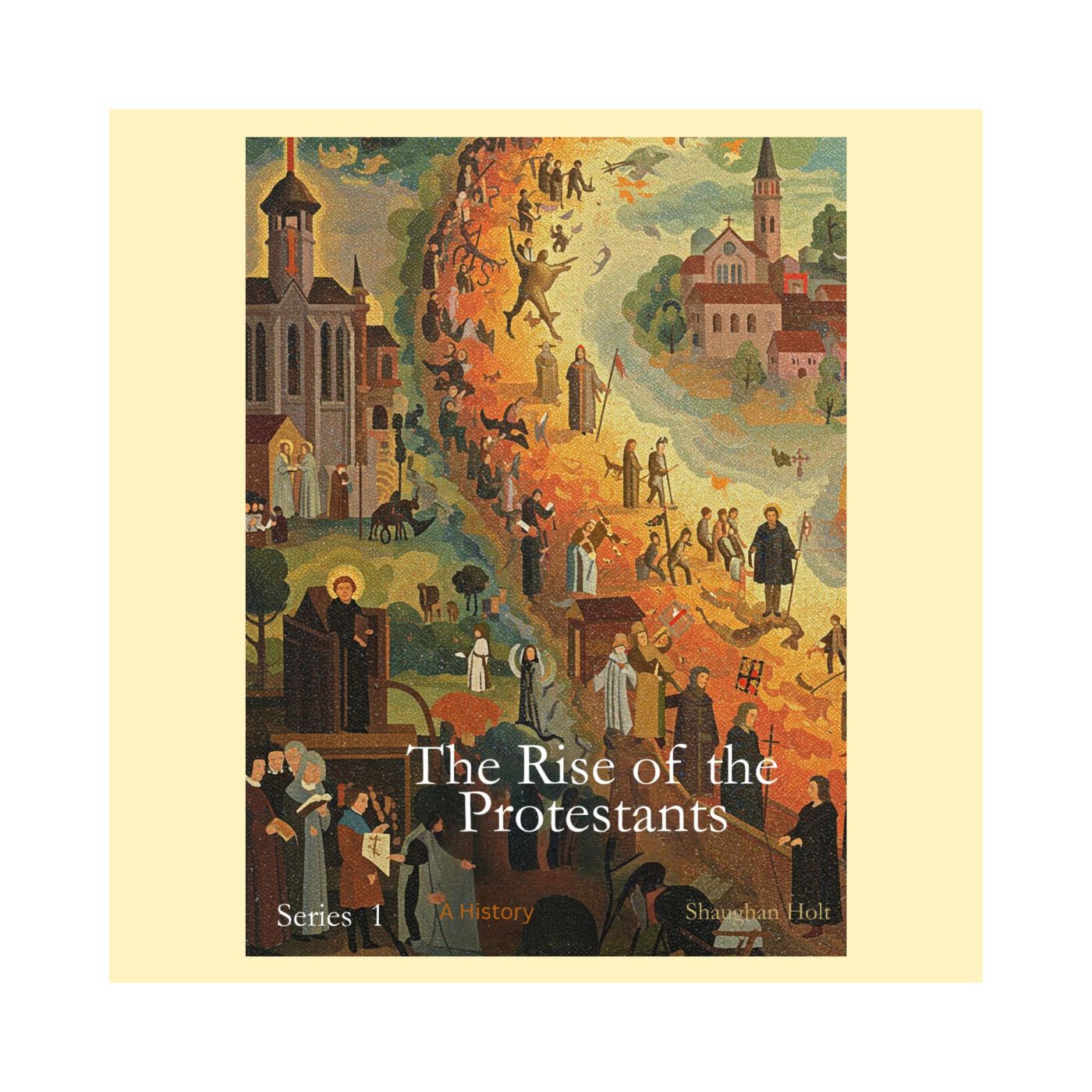
Episode 3
(new) Series 1 Episode 3 - The Protestant Boy King, Revised and Updated
Audio • Season 1 • Episode 3 • (new) Series 1 Episode 3 - The Protestant Boy King, Revised and Updated
Episode 3: The Protestant Boy King, Revised and Updated.
Since I first published this episode, I’ve gone back to the episode and incorporated your feedback.
As the series has grown, I've noticed a few areas that needed improvement or clarification, so I’ve updated parts of the original episode. The story and purpose are still the same, but I hope returning readers enjoy this updated version. If you’re new to the series, this is the starting point of our story.
The accompanying transcript also includes an epilogue with additional historical notes for those who would like to explore the story further.
Artwork • The Family of Henry VIII, c. 1543-1547
Music • John Taverner: Quemadmodum , Psalm 42, c.1540.
Notes:
In 1547, following the death of Henry VIII, his nine-year-old son, Edward VI, became the first English monarch to have been raised as a Protestant. His short reign would see England move much more decisively towards Protestant reform. But the changes taking place in England were part of a much wider religious upheaval across Europe.
In this episode, we explore the growing influence of Reformed Protestantism, through figures such as John Calvin and William Farel in Geneva, and Ulrich Zwingli in Zurich.
We also follow the emergence of the Anabaptist movement, with its rejection of infant baptism, and its belief that baptism should follow a personal profession of Christian faith.
Back in England, we follow the Protestant reforms of Edward VI's reign, the introduction of the Book of Common Prayer, and the influence of Archbishop Thomas Cranmer and continental reformers such as Peter Martyr Vermigli.
We also explore the religious divisions surrounding the Prayer Book, the rebellion of 1549, and the more strongly Protestant reforms that followed.
Finally, we come to Edward's illness and early death, the attempt to place Lady Jane Grey on the throne, and the accession of his Catholic half-sister, Mary.
Edward's reign lasted only six and a half years, but during that short period, the English Reformation had changed dramatically.
Those changes would leave a lasting influence on English Protestantism, and help shape the religious struggles that followed.
Transcript
© 20 26 The Rise of the Protestants. Author, Shaughan Holt.
"All rights reserved. No part of this podcast may be reproduced, translated, distributed, or transmitted in any form or by any means, including photocopying, recording, or other electronic or mechanical methods, without the prior written permission of the copyright holder, except in the case of brief quotations embodied in critical reviews and certain other non-commercial uses permitted by copyright law".
Requests regarding translation, licensing, or republication should be directed to: sholt@nashcom.co.uk.
Your feedback matters, send me an email, with any comments, suggestions, or criticisms. I read every message.
A Note About This Episode.
Episode 3: The Protestant Boy King, Revised and Updated.
Since I first published this episode, I’ve gone back to the episode and incorporated your feedback.
As the series has grown, I've noticed a few areas that needed improvement or clarification, so I’ve updated parts of the original episode. The story and purpose are still the same, but I hope returning readers enjoy this updated version. If you’re new to the series, this is the starting point of our story.
The accompanying transcript also includes an epilogue with additional historical notes for those who would like to explore the story further.
Series 1.
Episode 3.
The Protestant Boy King.
The English Reformation began during the 15 30s, when Henry VIII separated the Church of England, from the authority of the Pope and the Roman Catholic Church.
For several years, Henry sought an annulment of his marriage to Catherine of Aragon, but Pope Clement VII refused to grant it.
As the dispute continued, Henry and his government increasingly challenged papal authority in England.
In 15 33, Thomas Cranmer, the newly appointed Archbishop of Canterbury declared Henry's marriage to Catherine invalid, clearing the way for Anne Boleyn, to be recognised as his lawful wife.
The next year, the Act of Supremacy, officially made Henry VIII, the Supreme Head of the Church of England.
Thomas Cromwell, Henry’s main advisor, played a key role in these changes.
He supported religious reform, and helped strengthen the royal government.
However, England was not yet a completely Protestant country.
Henry continued to support some religious reforms, while remaining firmly attached, to many traditional Catholic beliefs and practices.
At the same time, the changes of the 15 30s created new opportunities for Protestant reformers, some of who believed that the English Church had not changed far enough.
People did not start using the word Puritan until the 15 60s, and at first, critics mostly used it, as an insult.
However, some of the ideas, later associated with Puritanism, had already begun to emerge among Protestant reformers, during the reign of Henry VIII, and would develop much further under his son, Edward VI.
These reformers thought, that even though Henry had rejected the Pope’s authority, the Church of England, still kept too many old ceremonies and practices, from the medieval Catholic Church.
They began to question the need for religious images, elaborate ceremonies, and traditional church clothing.
Instead, they preferred a simpler worship, focusing more, on Scripture, preaching and prayer.
Similar religious debates were happening across Europe at the same time.
By the 15 40s, major differences, had emerged between Lutheran and Reformed Protestants, especially over worship, religious images, and the meaning of the Eucharist.
These disagreements would become increasingly important in England.
While Henry VIII had broken with Rome, England, would experience a much more determined move toward Protestant reform, during the short reign of his young son, Edward VI.
John Calvin was born on 10 July 15 09, in Noyon, Picardy France.
He became one of the most influential theologians of the Protestant Reformation, and helped shape the Reformed tradition.
After adopting Protestant ideas, Calvin had to leave France, because persecution of religious reformers was getting worse.
He eventually settled in Basel, Switzerland, where, in 15 36, he published the first edition of his most important work, "the Institutio Christianae Religionis", or Institutes of the Christian Religion.
The Institutes provided a systematic explanation of Protestant belief, covering subjects including the nature of God, salvation through faith, the Church, the sacraments, and Christian liberty.
Calvin revised and expanded the work throughout his life.
It became one of the Reformation's most influential theological writings.
The first edition of the Institutes was published in 15 36, during a time of significant religious change in Europe.
That same year, Henry VIII began the dissolution of the monasteries in England, while William Tyndale, was executed for heresy.
While England was going through its own religious changes, new types of Protestant belief were also developing in continental Europe.
Later that year, while travelling through Switzerland, Calvin arrived in Geneva.
There, he met William Farel, a French Protestant reformer, working to establish the Reformed faith in Geneva.
Calvin had planned to keep travelling, as he preferred a quieter life, focused on study and writing.
However, Farel was determined to convince him to stay.
According to Calvin's later account, Farel warned him, that God would curse his studies, if he refused to help with the work of reform.
Calvin eventually agreed, and began his long, sometimes difficult relationship with Geneva.
Although Geneva would expel him in 15 38, he was allowed to return in 15 41.
The city would later become one of Europe's, most important centres of Reformed Protestantism.
Over time, his theology strongly influenced English reformers, and the growing Puritan movement.
Calvin had originally preferred a quieter life of study and writing, but over time, he became Geneva's leading religious figure.
He worked closely with William Farel, to create a disciplined Christian community, based upon Reformed beliefs.
Their reforms changed not only the way people worshipped, but also many aspects of everyday life in Geneva.
Catholic practices ended, religious images were removed from churches, and behaviour considered immoral or against Scripture was more strictly controlled.
People were expected to go to church and learn about religion, while gambling, drunkenness, adultery and other offences could be punished.
The Consistory, a religious court made up of ministers and lay elders, played an important role in enforcing church discipline.
Those brought before it, could face warnings, public reprimands, or exclusion from Communion, while Geneva's civil authorities, handled more serious punishments.
Calvin also placed great importance on education.
Schools were encouraged, with particular emphasis on Scripture, classical learning, and biblical languages, helping Geneva develop as an important centre of Protestant scholarship.
However, not everyone accepted Calvin’s reforms.
His attempts to impose greater religious discipline, brought him and Farel, into conflict with Geneva's governing authorities, and in 15 38, both men were ordered to leave the city.
Calvin spent the following three years in Strasbourg, before being invited to return to Geneva, in 15 41.
Farel did not return, but instead settled in Neuchâtel, but the two men remained close friends, and continued to correspond.
After Calvin returned, his influence grew, and Geneva, became one of Europe's main centres of Reformed Protestantism.
His teachings emphasised God's sovereignty, the authority of Scripture, and the belief, that salvation, depended entirely on God's grace.
Central to Calvin's theology was the doctrine of predestination.
Calvin taught that because humanity was corrupted by sin, people could not achieve salvation on their own.
He believed salvation depended on God's grace, which God freely gave to those he had chosen.
This belief, later became closely linked with Calvinism, and strongly influenced Reformed Protestant communities, throughout Europe.
Calvin also believed that Christian worship should be firmly based upon Scripture.
He rejected many ceremonies and practices, from the medieval Catholic Church, preferring simpler worship, focused on preaching, prayer, reading Scripture and the singing of Psalms.
Calvin also rejected the Catholic doctrine of Transubstantiation.
However, unlike some other Protestant reformers, he did not see the Lord's Supper as just a symbolic memorial.
He believed, that Christ remained physically in Heaven, but, through the power of the Holy Spirit, believers could receive Christ spiritually, when they shared in the Lord's Supper.
These ideas, along with Calvin's focus on Scripture, preaching, church discipline, and simpler worship, later had a strong influence on English Protestants.
Over time, many of these principles became closely linked with the growing Puritan movement.
The religious and social structures, created in Geneva, along with Calvin's writings, and the ministers trained there, helped spread Reformed ideas far beyond Switzerland.
In the years that followed, Geneva strongly influenced Protestantism in France, Scotland, the Netherlands, and England.
Geneva's influence became especially important, during the reign of Edward VI, and later for the English Protestants, who fled to Europe, during the reign of his Catholic successor, Queen Mary I.
William Farel would spend most of his later years in Neuchâtel.
He kept in touch with Calvin, and continued to help spread the Reformed faith.
He died in 15 65, after seeing the movement, he helped start in Switzerland, spread well beyond Geneva.
At the same time, another major leader of the Protestant Reformation was also nearing the end of his life.
Martin Luther, remained at the heart of the German Reformation, continuing to preach, write, and defend the religious changes, he had helped begin, nearly thirty years earlier.
Among the traditional teachings Luther rejected, was Purgatory, the Catholic belief in a state of purification after death, for those who would ultimately enter Heaven.
Luther believed, that salvation came from God's grace, received through faith, not from human actions, or the system of indulgences, he had famously opposed.
Martin Luther, died on 18 February 15 46, in Eisleben Saxony, at age 62.
He was still excommunicated, from the Roman Catholic Church when he died.
His body was taken to Wittenberg and buried in the Castle Church.
This church is known as the place, where he began his protest against the sale of indulgences.
By the time Luther died, the Reformation had spread far beyond the German lands where it started.
Lutheran churches had become established across parts of northern Europe, while the Reformed movement, associated with figures such as Zwingli and Calvin, was developing separately, in Switzerland and beyond.
England would take a different path.
Henry VIII had broken with Rome, but resisted many Protestant doctrines, and continued to defend, much of the Catholic Church's traditional beliefs.
However, Henry had less than a year left to live.
When Henry died in January 15 47, the Crown passed to his nine-year-old son, Edward VI.
With the young King on the throne, the English Reformation, was about to enter a new phase, as England would move, much more decisively, toward Protestant reform.
Another key branch of the Reformation, had started in Switzerland, led by Ulrich Zwingli.
Zwingli was born in January 14 84, in Wildhaus Switzerland, and became the leading Protestant reformer in Zurich.
Like Luther, he rejected the authority of the Pope, but his understanding of Christianity developed in a distinctly different direction.
Zwingli believed Scripture, should be the main religious authority, and that Christian society should follow, the Bible's teachings.
He worked with Zurich’s leaders, believing that religious and political reforms should go hand in hand, to build a Christian community.
However, some of his younger followers grew frustrated, with what they saw, as the slow pace of reform.
Among them were Conrad Grebel and Felix Manz, who increasingly questioned, whether practices inherited from the Catholic Church, could be justified by Scripture.
One of the most important of these questions concerned infant baptism.
Grebel and his companions believed, that baptism should only come, after someone makes a conscious profession, of Christian faith.
They argued it should only be given to people, old enough to decide for themselves.
Zwingli disagreed with them.
The dispute, grew increasingly serious, and in January 15 25, the Zurich authorities ordered that infant baptism continue, and that those opposing it, must end their separate religious gatherings.
The radicals refused to comply.
On the evening of 21 January 15 25, a small group, gathered at the home of Felix Manz in Zurich.
It was there, that George Blaurock, a former Catholic priest, asked Conrad Grebel to baptise him, following his profession of faith.
Grebel agreed, and Blaurock then baptised the others who were present.
This event marked a defining moment, in the emergence of the movement that would become known as Anabaptism.
The term Anabaptist, which means "one who baptises again," was first used by critics of the movement.
They accused its members of rebaptising people, which was considered a serious crime at that time.
The Anabaptists themselves rejected the description, because they did not regard infant baptism as valid, and therefore, believed that baptism following a personal profession of faith was not a second baptism, but their first, true, Christian baptism.
The authorities in Zurich responded harshly.
Anabaptist gatherings were banned, and people who refused infant baptism, risked being imprisoned, exiled or even executed.
Zwingli himself, continued to lead the Reformation in Zurich, but religious divisions within Switzerland, increasingly brought the Protestant and Catholic cantons, into conflict.
In 15 31, these tensions led to the Second War of Kappel.
After Zurich and its allies, attempted to place economic pressure, on the Catholic cantons, a Catholic army advanced against them.
Zurich was caught unprepared.
On 11 October 15 31, Zwingli accompanied the Zurich army, to the battlefield at Kappel, where he was killed.
However, Zwingli's death did not end the Swiss Reformation.
Heinrich Bullinger continued his work, succeeding him in Zurich, and helping consolidate the Reformed tradition Zwingli had begun.
At the same time, the Anabaptist movement survived, despite persecution, and spread to parts of Switzerland, Germany and the Netherlands.
But their differences went far beyond baptism.
Many Anabaptists believed, that the Church should be a voluntary community of committed believers, rather than a religious institution, to which everyone automatically belonged at birth.
They also began to argue more strongly, that the Church should stay independent, from government control.
These beliefs challenged an established order, in which religious and political authority, were closely connected.
As a result, Anabaptists faced severe persecution, from both Catholic and Protestant authorities.
One of the movement's most important later leaders was Menno Simons, a former Catholic priest from the Netherlands, who joined the Anabaptist movement during the 15 30s.
Following the violence and upheaval, associated with some earlier Anabaptist groups, Menno helped unite many of the surviving peaceful communities.
He focused on believers' baptism, Christian discipleship, keeping Church and State separate and practising non-violence.
His influence grew so much, that many of his followers were eventually called Mennonites.
Although Anabaptism eventually developed several different branches, its ideas survived, and continued to play an important part in the wider story of Protestant dissent.
Today, Mennonite communities are still active, especially in North America, Europe, Africa, Asia and Latin America.
As these new Protestant movements, spread across continental Europe, big changes, were also about to take place in England.
In January 15 47, following the death of Henry VIII, his nine-year-old son, Edward VI, became King of England.
Edward was the first English monarch, to be raised as a Protestant.
Because he was so young, a Regency Council ruled England.
At first, his uncle, Edward Seymour, the Duke of Somerset, took charge as Lord Protector.
Somerset, led the government during the first two years of Edward's reign, and supported the expanding Protestant reforms.
When Somerset lost power in 15 49, John Dudley, who later became the Duke of Northumberland, took over as the main leader in Edward's government.
Under Dudley, Protestant reform continued, and as Edward grew older, the young King himself, became increasingly involved in government, and strongly supported its Protestant direction.
Edward's accession marked a major turning point in the English Reformation.
Although Henry VIII had broken with Rome, he still supported many traditional Catholic beliefs.
Under Edward, the government would move much more decisively, towards Protestantism.
Religious images and traditional ceremonies were increasingly removed, prayers for the dead were abolished, and the clergy were permitted to marry.
Archbishop Thomas Cranmer’s reforms, also led, to a new English liturgy.
In 15 49, the first Book of Common Prayer was introduced, providing a standard form of worship, in English, for churches across the country.
A substantially revised version, followed in 15 52, moving the Church, even further towards Protestant belief and worship.
But religious reform was not the only important issue facing the young King's reign.
Edward's accession also raised questions about the future succession.
The Third Succession Act, passed when Henry VIII was king, put his daughters, Mary and Elizabeth, back in line to inherit the throne, after Edward and any children he might have.
Even though both daughters, were still legally illegitimate, their father’s rules meant they could still inherit the Crown.
In Edward’s first year as king, Parliament also passed the Treason Act of 15 47.
One part of the Act, made treason trials safer, by usually requiring two witnesses to support certain accusations.
Meanwhile, Protestant reformers were seeking much greater changes within the Church of England.
Cranmer had maintained contact with reformers across continental Europe, and England increasingly became a refuge, for Protestant scholars fleeing religious persecution.
One of the people invited to England, was the Italian reformer Peter Martyr Vermigli, whose ideas, became especially important during Edward’s reign.
Vermigli accepted Cranmer's invitation and travelled from Strasbourg, where he had been teaching theology, to England in late 15 47.
In 15 48, he became Regius Professor of Divinity, at Oxford University.
This was a significant role, at a university, where many, still resisted Protestant reform.
His teaching, especially about the Eucharist, soon led to disagreements, with those who defended traditional Catholic beliefs.
At the same time, Edward's government began bringing religious reforms, to every parish in England.
The biggest change happened, when the Book of Common Prayer was introduced in 15 49.
Archbishop Thomas Cranmer was mainly responsible for the Prayer Book, which created a single English liturgy, and replaced Latin services used for centuries.
Although the 15 49 Prayer Book leaned toward Protestant ideas, it still kept many traditional forms and language from the medieval Church.
Even so, introducing the Prayer Book was a major change.
For the first time, parish churches all over England had to use the same approved form of worship, in English.
However, not everyone was happy about these changes.
There was especially strong opposition, in the counties of Devon and Cornwall, where the new Prayer Book helped spark a major uprising in the summer of 15 49.
The rebellion began around Pentecost, celebrated fifty days after Easter, and marking the Holy Spirit's descent on the disciples.
The rebels wanted to restore traditional religious practices, including the Latin Mass, and rejected many of the Protestant reforms, introduced since Henry VIII had died.
This uprising became known as the Prayer Book Rebellion.
During the unrest, Vermigli temporarily left Oxford, and joined Archbishop Cranmer at Lambeth Palace in London.
The rebellion was eventually suppressed by government forces, with considerable loss of life.
However, the controversy surrounding the Prayer Book also revealed opposition, from a very different direction.
While traditionalists believed the reforms had gone too far, some Protestant reformers believed they had not gone far enough, arguing that the 15 49 Prayer Book, retained too many elements of traditional Catholic worship.
As a result, Cranmer continued to revise the English liturgy, increasingly influenced by Reformed Protestant theology, and by continental reformers such as Vermigli.
This led to the second Book of Common Prayer, which was introduced in 15 52.
This new version was much more Protestant than the first one, especially in how it described the Eucharist.
It also removed or changed many practices that seemed to support the traditional Catholic Mass.
These changes showed, just how quickly the English Reformation, was moving forward under Edward VI.
In just a few years, England had gone from Henry VIII's uneasy mix of reform and tradition, to a Church, increasingly shaped by Protestant ideas.
During his time at Lambeth Palace, Vermigli became more involved in the religious debates of the English Reformation.
After the unrest of 15 49 ended, Vermigli returned to Oxford, where he continued teaching and defending his increasingly Reformed view of the Eucharist.
At the same time, Cranmer started working on a new version of the Book of Common Prayer.
Vermigli and the German reformer Martin Bucer, were both asked for their opinions, and they gave detailed feedback on the 15 49 Prayer Book.
Their input was part of a larger movement that led Cranmer and the English Church, to adopt a more clearly Reformed view of the Eucharist.
Cranmer had already moved far from traditional Catholic teaching, but his talks with reformers like Vermigli and Bucer, helped guide his developing beliefs.
These changes appeared in the updated Book of Common Prayer, which was published in 15 52.
This new Prayer Book, left out many traditional elements from the earlier version, and made the Protestant view of worship, and the Eucharist much clearer.
Vermigli also influenced the broader theological debates, that led to the Forty-Two Articles of Religion, published in 15 53.
These Articles, attempted to define the doctrine, of the newly Reformed Church of England, addressing subjects including Scripture, justification, the sacraments and predestination.
Although Edward's death would prevent the religious settlement from becoming firmly established, many of its Protestant reforms and ideas survived.
They would later influence the Elizabethan Religious Settlement, and importantly the Thirty-Nine Articles, which became the defining statement of doctrine for the Church of England.
The revised Book of Common Prayer came into official use in England in November 15 52.
The Communion service had changed considerably.
Altars were replaced by communion tables, and the service moved further away from the traditional Catholic understanding of the Mass.
The new Prayer Book also introduced several familiar features, including opening sentences from Scripture, followed by an Exhortation, Confession, and Absolution at Morning and Evening Prayer.
It removed many of the traditional features retained in the earlier version, and expressed a much more clearly Protestant understanding of worship and the Eucharist.
Vermigli's influence can also be seen in the wider theological debates, that contributed to the Forty-Two Articles of Religion, issued in 15 53.
These Articles attempted to define the doctrine of the newly Reformed Church of England, addressing subjects including Scripture, justification, the sacraments, and predestination.
Although Edward's death would prevent the religious settlement from becoming firmly established, many of these ideas survived.
They would later influence the Elizabethan Religious Settlement, and the Thirty-Nine Articles, which became an important statement of belief within the Church of England.
Vermigli left England after the Catholic Queen Mary took the throne in 15 53, but his influence on English Protestantism continued long after his departure.
His writings remained influential among later generations of Reformed Protestants, particularly within the English Puritan tradition.
Vermigli eventually returned to continental Europe, settling in Zurich, where he continued to teach and write.
He died there on 12 November 15 62, at the age of 63.
But Edward's new Prayer Book would remain in use for only a matter of months.
By early 15 53, the fifteen-year-old King was seriously ill.
As his condition deteriorated, the question of who would succeed him became increasingly urgent.
Edward was determined that the Protestant Reformation should continue, and feared that his Catholic half-sister Mary would reverse the religious changes made during his reign.
He therefore attempted to alter the succession, excluding both Mary and Elizabeth, and placing Lady Jane Grey and her Protestant heirs in line for the throne.
Edward VI died on 6 July 15 53, at Greenwich, aged just fifteen.
His reign had lasted only six and a half years.
Yet during that short period, England had undergone some of the most dramatic religious changes of the Reformation.
The old Mass had given way to an English Communion service, priests were allowed to marry, and many religious images and traditional ceremonies had disappeared from churches.
By the end of Edward's reign, the Church of England had become much more firmly Protestant.
But Edward's religious settlement remained fragile.
Lady Jane Grey was proclaimed Queen, but her reign lasted only nine days.
Support quickly gathered around Mary, the daughter of Henry VIII and Catherine of Aragon, and she entered London as Queen.
England now had its first ruling Queen.
And she was a committed Catholic.
The Protestant Reformation established under Edward VI, was about to face its greatest challenge.
Epilogue
Purgatory.
In Catholic teaching, Purgatory is where people who die in God's grace are purified if they are not yet ready to enter Heaven.
Purgatory is very different from Hell. People in Purgatory are not condemned; they are on their way to Heaven.
The idea of purification after death developed slowly in the early and medieval Church.
Early Christians prayed for the dead, believing such prayers could assist them.
A key biblical passage supporting this practice is found in the Second Book of Maccabees, which describes prayers and offerings for the dead.
The Books of the Maccabees are ancient historical writings about the Jewish rebellion against the Greek Seleucid Empire in the second century BCE.
The Books are included in the Catholic Old Testament, but most Protestants later chose not to accept it as part of their biblical canon.
In the middle Ages, ideas about Purgatory became much more detailed.
The Latin word, “Purgatorium”, which means a place of purification or cleansing, became common in the twelfth century.
People started to picture Purgatory as a specific place or state that souls passed through before reaching Heaven.
Medieval writers often described Purgatory as a place of suffering and cleansing by fire. However, the Catholic Church did not officially define it as just a physical place of fire.
Several medieval Church councils discussed the doctrine of Purgatory, such as the Second Council of Lyon in 12 74 and the Council of Florence in the fifteenth century.
Purgatory also became linked to prayers and Masses for the dead, as well as the medieval practice of indulgences.
The Church taught that an indulgence could lessen the punishment left after sins were forgiven.
By the late middle Ages, indulgences were also linked to the dead, leading many to believe that the living could help souls being purified in Purgatory.
This issue became especially important during the Protestant Reformation.
Martin Luther’s protest against selling indulgences in 15 17 raised serious questions about whether the Church had the authority to make promises about the fate of the dead.
As Luther’s ideas developed, he rejected Catholic teaching on Purgatory more strongly.
Luther believed that salvation depended on God’s grace and was received through faith.
He also argued that there was not enough support in Scripture to prove the existence of Purgatory.
Other Protestant reformers went even further, and rejecting Purgatory became a major difference between Protestant Christianity and the Roman Catholic Church.
In England, this view eventually became part of the teachings of the Reformed Church of England.
Article XXII of the Thirty-Nine Articles rejected what it called the, “Romish Doctrine concerning Purgatory”, along with several other practices associated with medieval Catholicism.
However, the Catholic Church continued to defend the doctrine during the Reformation.
At the Council of Trent, held from 15 45 to 15 63, the Church reaffirmed the existence of Purgatory and the belief that prayers from the living could help the dead.
As a result, Purgatory became one of the many theological issues that the Reformation created or made more pronounced.
The doctrine is still part of Catholic teaching today, though modern explanations usually describe Purgatory as a state of final purification instead of a physical place.
The word 'purgatory' has also become part of everyday English.
Today, saying someone is “in purgatory” often means they are going through a tough or unpleasant time, especially one they hope will end soon.